
Your Backup Alarm is Lying to You
Why ‘Beep-Beep’ Isn’t Enough to Protect Your Crew
On any active worksite, from a sprawling quarry to a congested city street during waste collection, the constant “beep-beep-beep” of a vehicle in reverse is the unquestioned soundtrack of the day. For decades, this sound has been the universal, compliance-ticking signal for “WATCH OUT!”. It’s a sound everyone hears. But in an environment saturated with noise, does anyone truly listen?
The hard truth is that your backup alarm is creating a dangerous illusion of safety. It’s lying to your drivers and your ground crew by equating a simple, undifferentiated noise with genuine situational awareness. We’ve become so accustomed to this sound that we’ve accepted the lie. But on a busy site where a single moment of inattention can be catastrophic, this reliance on an easily ignored, contextless alarm is a profound failure of modern safety protocols.
The Three Lies of the Traditional Backup Alarm
The familiar beep has become ineffective not just because it’s ignored, but because the information it provides is critically incomplete.
The Lie of Presence: A backup alarm signals that a vehicle is in reverse. It does not signal the actual presence of a hazard. It beeps the same in a completely empty lot as it does when a person is standing inches from the tire in a blind spot. It lacks the intelligence to differentiate a genuine risk from an empty space.
The Lie of Intent: A simple sound cannot analyze movement or trajectory. It cannot tell a driver if a nearby vehicle is on a collision course or if a ground worker is distracted and unaware of their proximity. This was a key concern raised by customers who acknowledged that ground crew are often desensitized or distracted. The alarm simply announces a condition; it doesn’t analyze the risk.
The Lie of Context: The alarm reports on the vehicle’s action, not the environment’s condition. It only indicates that the vehicle is in reverse, but nothing about what is in the truck’s path. By sounding an urgent alert even when no hazard exists, it conditions drivers to tune out the noise. The lie is that a simple ‘beep’ is a substitute for actual awareness of the people, vehicles, or objects in the immediate vicinity.
Moving Beyond the Beep: A Multi-Layered System of Truth
To combat alert fatigue and provide actionable information, a modern safety solution must replace the single “dumb” beep with layers of intelligent contextual data.
Layer 1: Absolute Visual Verification
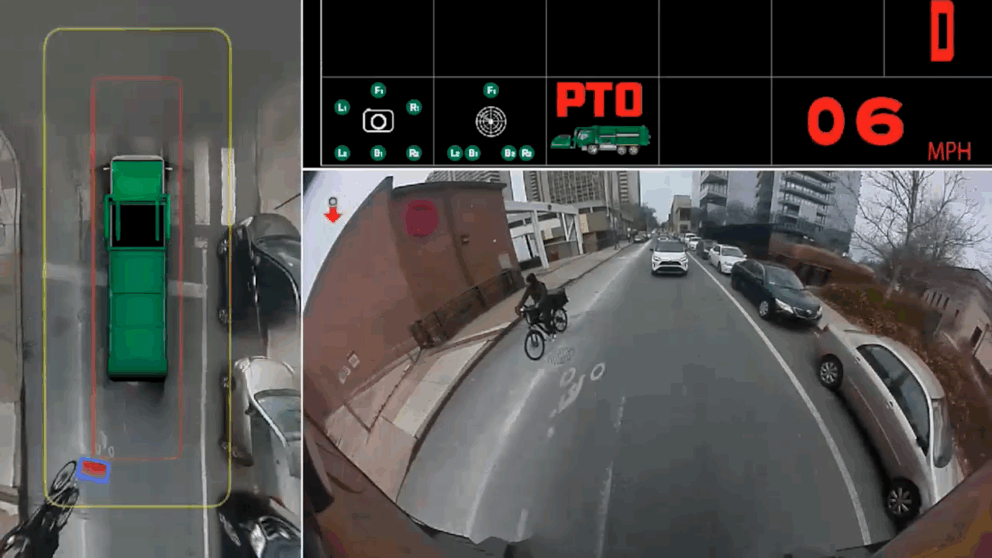
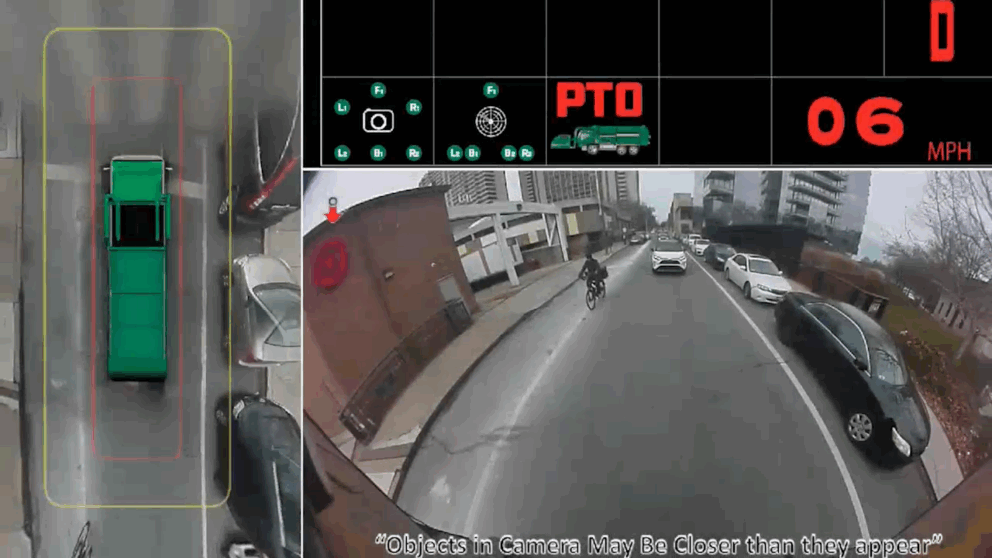
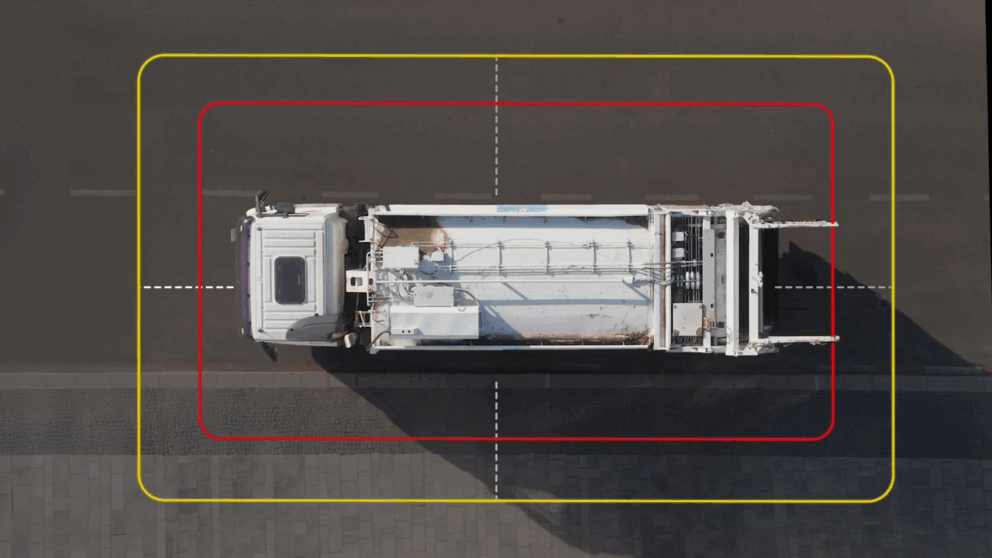
The most effective way to eliminate blind spots is with vision. A 360° bird’s-eye view, stitched together from high-definition cameras, gives the driver a complete, real-time picture of their surroundings on an in-cab monitor. When a hazard is detected, the in-cabin screen displays a blue box highlighting the location of the specific person/vehicle/object in the detection zones (yellow for warning, red for critical) around the vehicle, turning an ambiguous alert into a concrete visual fact that demands a response.
Layer 2: Intelligent Perception with Sensor Fusion
Relying on a single technology is a weakness. That’s why advanced systems employ sensor fusion, leveraging the strengths of multiple sensor types for maximum accuracy and reliability in all conditions.
• AI Cameras act as the “eyes,” classifying what they see, differentiating a person from another vehicle or a stationary object.
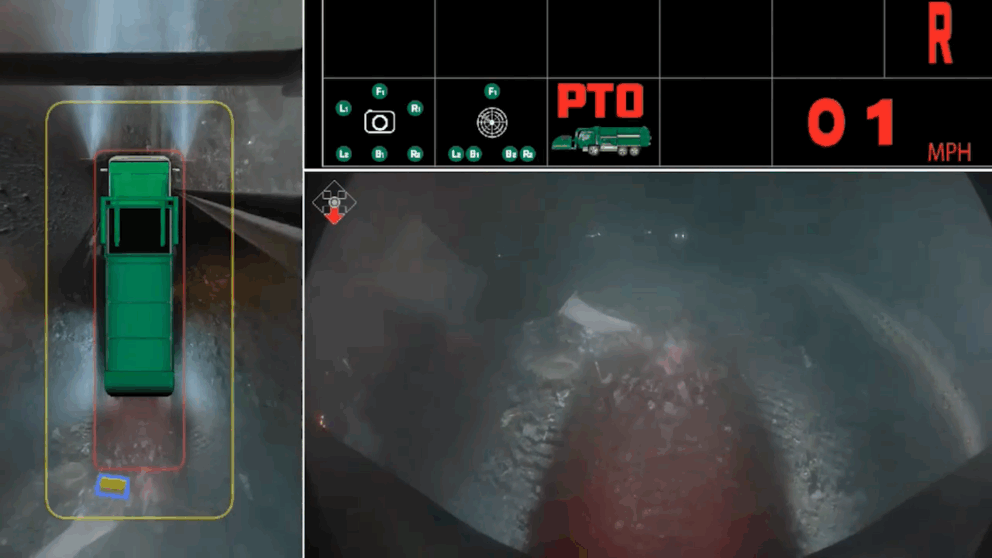
• Radar provides steadfast detection in visually obscured environments like heavy rain, dust, or complete darkness, where cameras might struggle.
• These components are ruggedized and weather-sealed (IP69K-rated) to withstand the harsh conditions of waste collection and recycling.
Layer 3: Dynamic and Responsive Alerts
A smart system delivers smart warnings. Instead of one sound for all situations, alerts become dynamic and responsive.
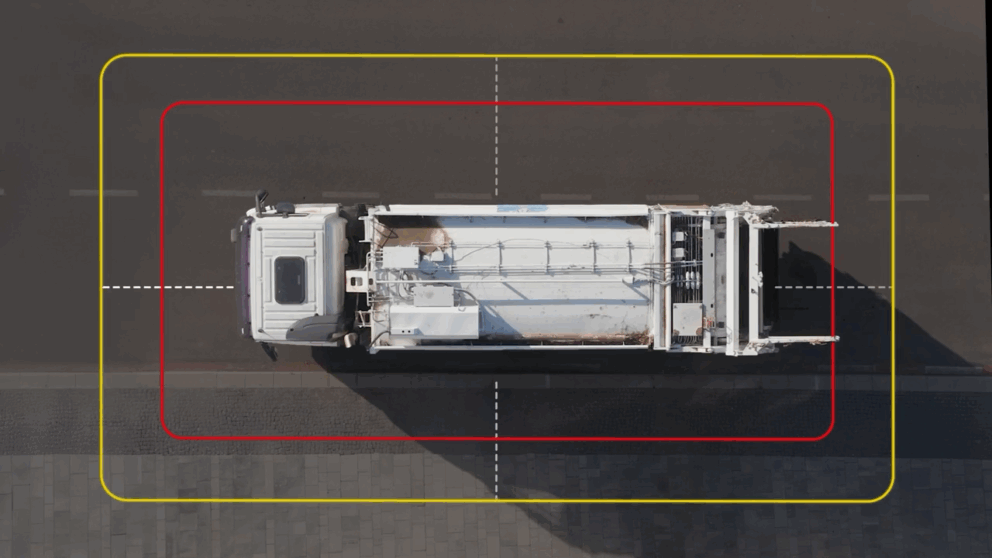
• Logic-Based Warnings: Alerts can be tied to vehicle dynamics. The detection zones (yellow: warning, red: critical) around the vehicle can be customized. Context-aware logic avoids unnecessary alerts; only activating alerts based on the vehicle’s gear (forward or reverse) and a directional camera’s detection of a person, vehicle or object.
Even more advanced is Time-to-Collision (TTC) Logic, a predictive safety feature that analyzes the real-time trajectory of nearby objects to calculate the likelihood of a collision. By issuing alerts only when a genuine threat is detected, it reduces unnecessary warnings and helps operators avoid alert fatigue. This allows drivers to focus their attention on real dangers and respond more safely.
• External Lights and Sirens: This crucial feature alerts the person outside the vehicle who is most at risk. This is designed to cut through distractions like cell phone use and continues to sound until the person has moved to a safe location.
From a Momentary Beep to an Actionable Database
Perhaps the biggest lie of the old backup alarm is that its job is done after the sound fades. A modern safety system’s work has just begun. All alerts and near-misses are logged and become data points for creating a safer operation. With a cloud-based platform, managers can conduct a proactive safety audit by:
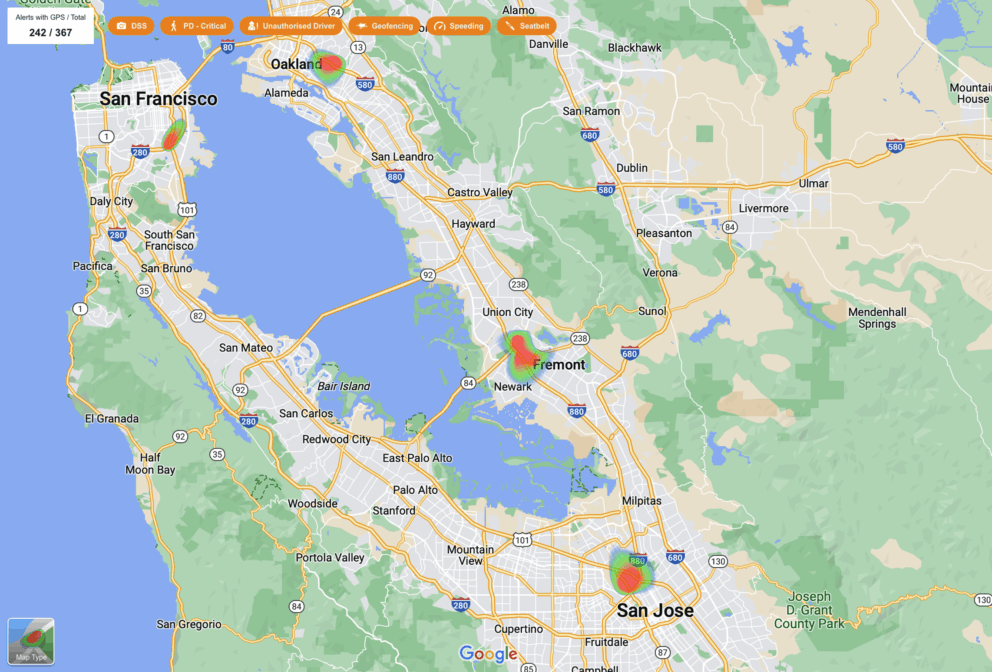
• Identifying Hazard Hotspots: The cloud-based platform would allow using heat map analytics to discover the specific intersections, transfer station zones, or parts of a route where near misses are most frequent, enabling you to redesign traffic flows or retrain for specific scenarios.

• Creating Objective Incident Reports: After an event occurs, a full HD video recording of it can be locally or remotely retrieved from the system installed on the vehicle and saved with vehicle speed and driver action data to create an objective and indisputable record for incident analysis and insurance purposes.
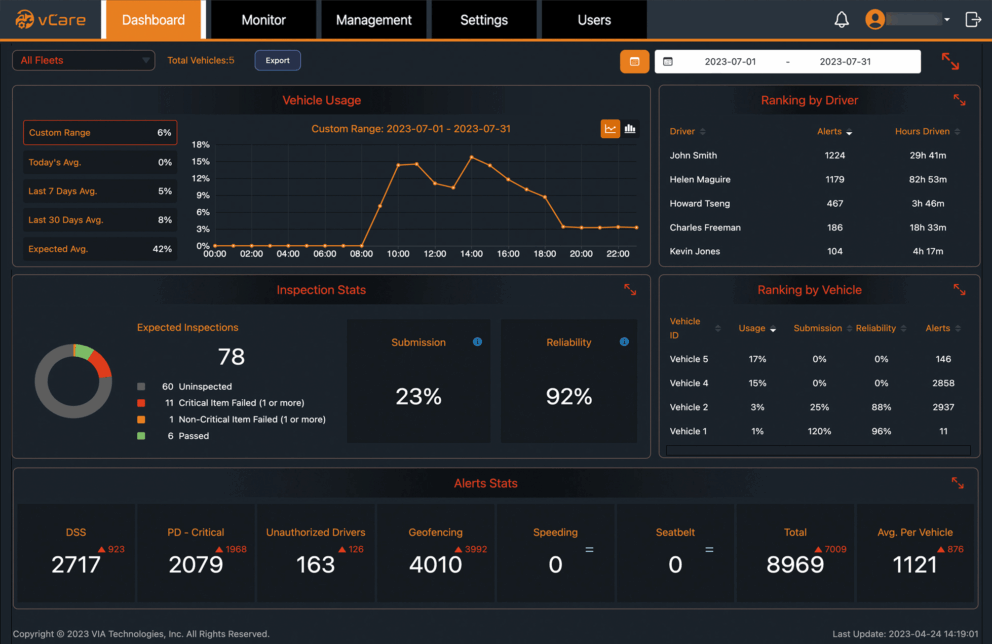
• Enabling Data-Driven Coaching: The cloud-based platform would allow driver-specific incident tracking and coaching. Instead of saying, “Be more careful in reverse,” a manager can sit down with a driver and say, “Let’s review the video from Tuesday at the main transfer station. You can see how this loader entered your blind spot. Let’s talk about the best way to approach that area.”
It is time to stop accepting the false sense of security offered by a simple beep. Your crews, your vehicles, and your communities deserve a safety solution that tells the whole truth. By embracing a multi-layered approach of cameras, radar, and data analytics, you can finally move from minimum compliance to maximum safety.